The Impact of Climate Change on Human Activity
I. The impact of climate change on human healthII. The impact of climate change on agriculture
III. The impact of climate on sea level rising and how it would affect humans
IV. Impact of climate change on weather extremes and natural disasters
I. The impact of climate change on human health
Global climate change poses serious risks to human health. Millions of people could be affected, and most doctors and scientists anticipate that most of the impacts will be adverse. These adverse impacts include:
- Increase in mortality due to warmer climate and increased heat waves. Extensive research has shown that heat waves cause excess deaths.
- Increase in infectious disease
- malaria
- dengue fever
- cholera
- encephalitis
- Increases in malnutrition in some areas, damages to sanitation infrastructure, and the creation of refugees from sea-level rise and storm surge
However, others claim that cold, not heat, is the biggest killer. Two studies have reached similar conclusions, and they both contest that a warmer climate would cause fewer fatalities and there is no reason to fear global warming. They have calculated that a world 2.5 degrees celsius hotter would save about 40,000 lives anually.

II. The impact of climate change on agriculture
At the global level, mean climate changes in the next century are unlikely to cause a dramatic decrease in world agricultural production. For the world as a whole, modest decreases in agriculture potential in one region are likely to be offset by gains in another region. However, the prospects for agriculture are still uncertain. Some of the impacts of climate change on agriculture that may occur are:
- Increased concentration in CO2 may increase agricultural productivity
- A warmer climate may reduce soil moisture
- Mid-latitude yields may be reduced by 10-30% due to increases summer dryness
- Raising sea levels increase liklihood of extreme weather events such as storms, flooding, and hot spells that will adversely impact agriculture.
- Climate and agricultural zones would tend to shift towards the poles
- Increase temperature may extend the geographic range of some insect pests currently limited by temperature.
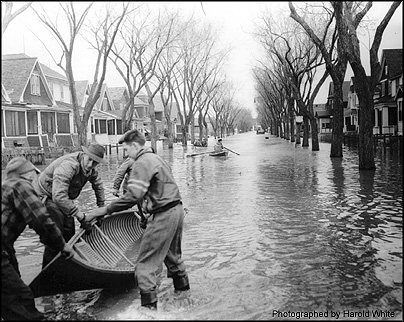
1950 flood of Manitoba, Canada
III. The impact of climate on sea level rising and how it would affect humans
Rise in sea level is expected to have a great impact on human activity. Records have shown that the global mean sea level has risen 4-6 inches during the past 100 years. With warmer climates, this is expected to increase even more. Why is this threatening to humans?
- Nearly 75% of Americans live on or within 50 miles of the coast
- Rising sea level will increase
- coastal erosion
- pollution
- storm damage
- flooding and other extreme weather events
- Intruding salt water may contaminate groundwater supplies
- Coastal erosion may have a negative impact on travel and tourism
- Many coastal fisheries will be adversely affected
- Coastal erosion will make less land available for agriculture
IV. Impact of climate change on weather extremes and natural disasters
Of all aspects of climate variability, extreme weather events are likely to have the greatest effect on human well-being in the decades to come. Any shift in mean climate will almost definitely result in a change in the frequency of extreme weather events. However, because extreme weather events are relatively short in duration, it makes it difficult for scientist to predict how the character of these events might respond to climate change. Most scientists agree that a warming of the tropical oceans should result in an overall increase in the frequency, and perhaps, the severity of cyclones. Also, increased sea level rise will increase flooding. Why is this even a greater concern today than it was 10 years ago?
- Many people in parts of the world are being forced to live in high risk zones because of overpopulation.
- Many high value property is being developed in high risk zones