Global Warming and World ClimateGlobal warming has been one of the"hottest" topics of discussion in recent years, as everyone from climatologists to oil companies to environmentalists have argued the effect of human activity on world climate. Amidst this controvesy, the scientific community has reached a consensus. Based on a global warming assessment involving more than 2,000 of the world's top climate scientists, the Intergovernmental Panel on Climate Change (IPCC) in 1995 concluded, "The balance of evidence suggests a discernible human influence on global climate." But what exactly does this mean to us? To answer this, we must adress two questions:
Weather and climate are driven by the sun's energy. Solar energy heats the earth's surface and, in turn, the earth radiates the light energy back into space. Water vapor, carbon dioxide, methane, and nitrous oxide, all atmospheric greenhouse gases, trap some of the outgoing light energy, thereby retaining heat just in the way glass panels of a greenhouse would function. This natural "greenhouse effect" causes the average temperature of the earth to remain at approximately 60 degrees F, a very hospitable temperature for life. However, due to the increasing atmospheric concentrations of greenhouse gases, temperatures have been on the rise. In fact, since the inception of the Industrial Revolution, carbon dioxide concentrations have risen 27%, methane concentrations have more than doubled and nitrous oxide concentrations have increased by approximately 15%. Essentially, increasing amounts of these gases in space enhances the ability of the earth's atmosphere to trap heat. This accounts for the fact that 1998 was the warmest year in the last 1200 years followed by 1997 and 1995.
Why are the greenhouse gas concentrations on the rise? The primary reasons for the changing atmosphere composition are human activities, namely the combustion of fossil fuels (gasoline, oil, natural gas or coal) and sustained deforestation. The decomposition of organic matter, accompanied by plant respiration, actually emits 10 times more carbon dioxide than is released by human activities. These natural emissions, however, are in balance with the absorption by plant photosynthesis of carbon dioxide. The changes in greenhouse gas concentrations, most drastically carbon dioxide, are caused then by energy burned to heat our homes, run our cars and operate our factories and businesses. Fossil fuel burning accounts for an estimated 80% of society's carbon dioxide emissions, 25% methane release and 20% nitrous oxide emissions. The United States released close to one-fifth of total global greenhouse gases in 1994. The ever increasing release of greenhouse gases is estimated by year 2030 to cause a doubling of pre-industrial carbon dioxide concentrations. If, however, current levels of carbon dioxide are stabilized globally, carbon dioxide doubling could be postponed to 2100. Furthermore, the data demonstrate that carbon dioxide accounts for 80.5% of total greenhouse gas emissions from developed counties with fossil fuel burning confirmed it as the paramount source of carbon dioxide.Mining, deforestation, landfills, industrial production and increased agriculture also play a role in rising emissions. Carbon dioxide effects increase when forests are cleared and increased agriculture causes methane and nitrous oxide release. If action is not taken shortly to lower concentrations of these greenhouse gases, global temperature could rise as much as 6 degrees in the next 100 years which could lead to major climate changes.
The Effect of Global WarmingThis temperature rise brought about by global warming is predicted to have several potentially drastic effects on the environment:
- Sea Level
- Hydrologic Cycle
- Climate Patterns
- El Niño
- North Atlantic Oscillation
Sea Level: When temperatures rise, there will be an inevitable increase in sea level as the polar ice caps melt and the already-existing ocean water expands when it is warmed. It is estimated that there will be an increase of approximately 50 cm in sea levels by the year 2100.
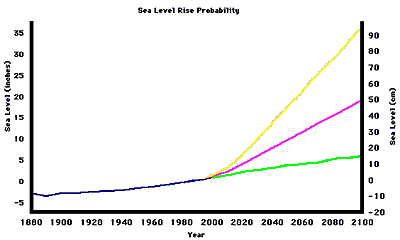
The blue line shows historical sea level rise over the past century. The green line represents a low projection of future sea level rise, the red, a central estimate, and the yellow, a high estimate.In addition, there is the possibility that the West Antarctic ice sheet could collapse into the sea as temperature increases over the next hundred years. As a result, sea level would rise even faster than currently predicted, perhaps as much as 65 meters world wide if all of the 27 million cubic kilometers of water trapped in this glacier were to melt completely.
Inevitably, this would result in flooding of many low level coastal areas, causing billions of dollars in damages and possibly displacing entire island populations.
Hydrologic Cycle: Many climatologists propose that global warming is also causing an increase in extreme weather events - specifically, flooding and droughts - as the hydrologic cycle is thrown out of its normal pattern. How does this happen? With the increase in temperature comes an increase in the evaporation of moisture from the earth's surface, which in turn raises the moisture content of the atmosphere. The heightened rate of evaporation is likely to exacerbate naturally occurring droughts, and the higher levels of water vapor in the atmosphere are predicted to enhance rainfall and snowfall events, which - along with the increase in sea level - will lead to a higher risk of flooding. In 1995, the National Climatic Data Center reported that precipitation over temperate regions of the northern hemisphere had increased 10 percent over the last century, while the frequency of extreme rain and snow storms had gone up 20 percent.While there is a great deal of uncertainty as to the impact the increase in temperature will have on specific regions of the world, it is becoming increasingly likely that there will be dramatic changes in precipitation patterns.
Climate Patterns: With regard to specific climate systems, research data is limited, but that which does exist points to likely effects on both the El Nino Southern Oscillation and the North Atlantic Oscillation. Results of recent investigations suggest that we have been setting ourselves up for some very extreme weather.El Niño: ENSO is intimately involved in the movement of heat around the Pacific Ocean and the bordering continents. In examining the statistical track record of El Niño, it is clear that there has been a shift in the intensity of this global weather pattern in the last twenty years which many scientists believe is the result of global warming. In examining all available data, oceanographers have concluded that the worst El Niño in the last 500 years occurred in 1982-83. The second worse El Nino occurred in 1997-98. The fact that these two are only 15 years apart has fueled discussion about global warming and the connection to human activity.Independent computer simulations performed at the Geophysical Fluid Dynamics Laboratory (GFDL) and the U.S. National Center for Atmospheric Research (NCAR) both suggest that carbon dioxide increases in the atmosphere result in a warmer Pacific ocean, especially in the eastern regions, and weak El Niño-like conditions as the norm. If the standard climate looks like El Niño and an actual El Niño occurs on top of this, it would explain an extreme year like 1997-98 and could easily lead to even worse conditions. El Niño is an example of the hydrologic cycle at its most intense, and as the planet warms, there is an increased chance that the hydrologic cycle will be pushed toward the extremes.
North Atlantic Oscillation: Throughout history, we have alternated between glacial and interglacial periods. Though it is still uncertain exactly what causes the shift between the two, it has been postulated that the underlying mechanism is connected to the North Atlantic Oscillation. When there is a large injection of freshwater at high latitudes (such as meltwater from glaciers and increased precipitation, both caused by global warming), the normal evaporation of warm surface water and normal sinking of cold, salt-heavy water in the north Atlantic is prevented. Over time, this results in a decrease in the circulation of warm water from the south Atlantic to the north, which in turn results in colder temperatures in the north Atlantic, perhaps dramatic enough to push us into another ice age. Winters in northern Europe have been relatively cold since 1996, and it has been suggested that we are in the midst of a failure of the normal thermohayline conveyor of the North Atlantic Oscillation. Will this be dramatic enough to produce an ice age? The research in this area is far from conclusive, but this theory must not be ignored.